

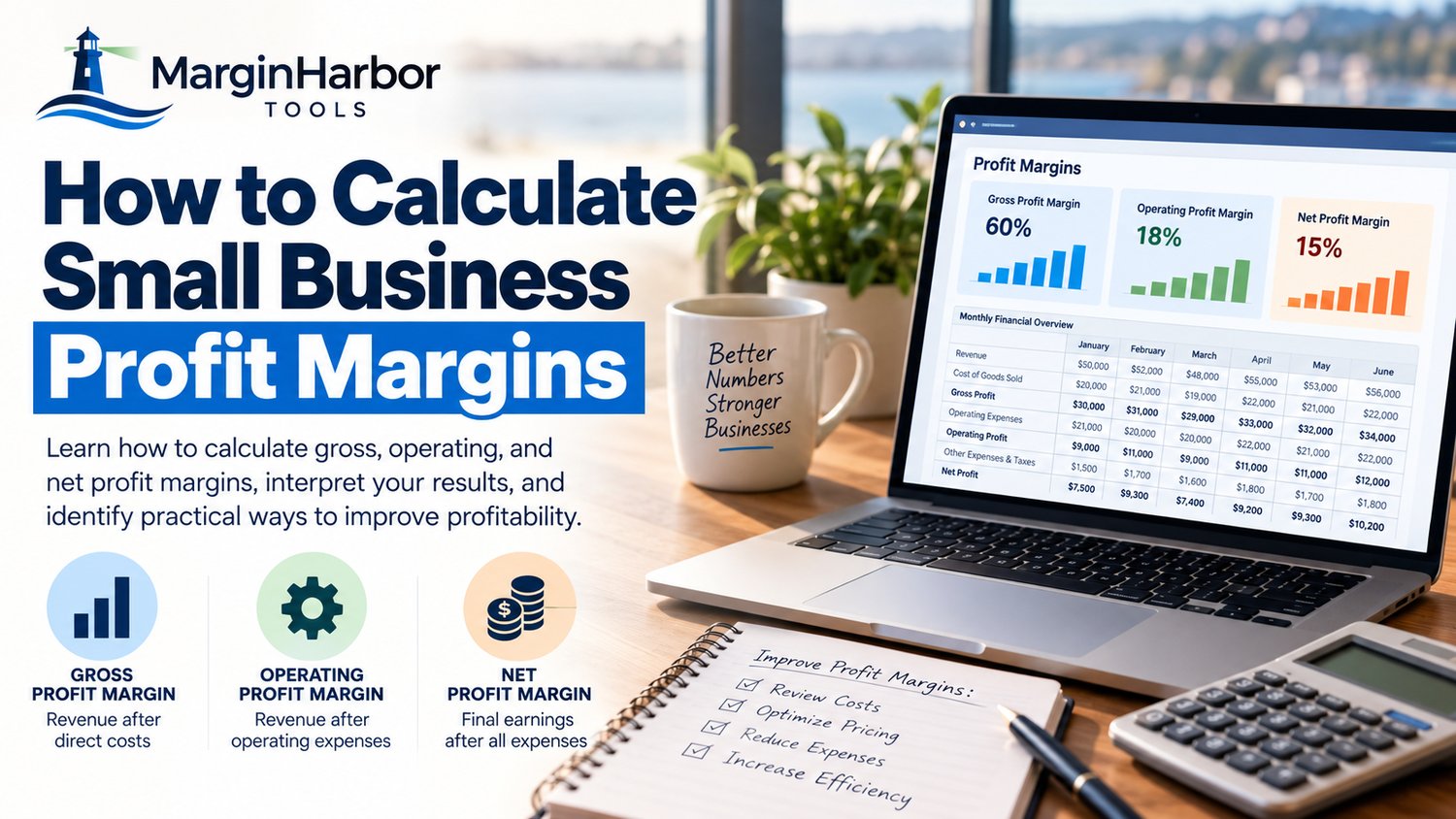
Understanding your small business profit margin is essential for making informed financial decisions. A company can generate impressive sales revenue and still struggle financially if operating expenses consume most of its earnings. Knowing how much profit your business retains from each dollar of revenue helps you evaluate pricing, control expenses, and identify opportunities for improvement.
Profit margins provide a clearer picture of financial performance than revenue alone. By tracking gross profit, operating profit, and net profit, business owners can understand where money is being earned, where it is being spent, and which adjustments may improve overall profitability.
What Is a Small Business Profit Margin?
A profit margin measures how much of your business revenue remains as profit after certain expenses have been deducted. It is expressed as a percentage, making it easier to compare financial performance across different months, products, services, or businesses.
The basic formula is:
Profit Margin = (Profit ÷ Revenue) × 100
For example, if your business generates $50,000 in monthly revenue and retains $7,500 in net profit, your net profit margin is 15%.
This means your business retains $0.15 in net profit for every dollar of revenue.
However, not all profit margins measure the same thing. Gross profit margin, operating profit margin, and net profit margin each reveal different aspects of business performance.
Understanding the Three Main Types of Profit Margins
Gross Profit Margin
Gross profit margin measures the percentage of revenue remaining after subtracting the direct costs associated with producing goods or delivering services.
These costs may include materials, inventory purchases, production labor, and certain direct service delivery expenses.
Gross Profit = Revenue − Cost of Goods Sold
Gross Profit Margin = (Gross Profit ÷ Revenue) × 100
Consider a small business generating $50,000 in monthly revenue with $20,000 in direct costs.
- Monthly revenue: $50,000
- Direct costs: $20,000
- Gross profit: $30,000
- Gross profit margin: 60%
The business retains 60% of revenue after its direct costs. That amount must still cover operating expenses and other financial obligations.
A declining gross margin may indicate rising supplier costs, excessive discounting, inefficient production, or changes in the products and services being sold.
Operating Profit Margin
Operating profit margin measures profitability after deducting both direct costs and ordinary operating expenses.
Operating expenses may include office rent, administrative payroll, insurance, marketing, and business software.
Operating Profit = Gross Profit − Operating Expenses
Operating Profit Margin = (Operating Profit ÷ Revenue) × 100
Continuing our example:
- Gross profit: $30,000
- Operating expenses: $21,000
- Operating profit: $9,000
- Operating profit margin: 18%
The business generates $9,000 in operating profit from $50,000 in revenue.
Operating profit margin helps owners determine whether their day-to-day business operations are financially sustainable.
Net Profit Margin
Net profit margin measures the percentage of revenue remaining after all recognized expenses, including applicable interest and taxes, have been deducted.
Net Profit Margin = (Net Profit ÷ Revenue) × 100
Continuing the same example:
- Operating profit: $9,000
- Other net expenses and taxes: $1,500
- Net profit: $7,500
- Net profit margin: 15%
The company retains 15% of revenue as net profit.
Net profit margin is particularly important because it reflects the final profitability of the business under its accounting method.
Example: Calculating Your Business Profit Margins
Consider a hypothetical business with the following monthly financial results.
Revenue and direct costs
- Total monthly revenue: $50,000
- Cost of goods sold: $20,000
- Gross profit: $30,000
- Gross profit margin: 60%
Operating performance
- Gross profit: $30,000
- Operating expenses: $21,000
- Operating profit: $9,000
- Operating profit margin: 18%
Final profitability
- Operating profit: $9,000
- Other net expenses and taxes: $1,500
- Net profit: $7,500
- Net profit margin: 15%
These calculations reveal three different financial outcomes.
The business retains 60% of revenue after direct costs, 18% after operating expenses, and 15% after all recognized expenses.
Understanding these differences helps identify which financial areas deserve attention.
What Is a Good Profit Margin for a Small Business?
There is no universal profit margin that every small business should achieve. Appropriate margins depend on the industry, business model, competitive environment, operating expenses, and financial objectives.
A professional services company may have relatively low direct material costs but substantial labor expenses. A retail business may operate with lower gross margins while relying on higher sales volume and efficient inventory management.
Rather than relying on a single percentage, compare your business against relevant benchmarks and its own historical performance.
Consider these questions:
- Are profit margins improving or declining over time?
- Are direct costs increasing faster than revenue?
- Are operating expenses growing faster than the business?
- Do individual products or services generate sufficient contribution?
- Does the current profit level support future business requirements?
The answers help determine whether your business is moving toward stronger financial performance.
How to Improve Your Small Business Profit Margins
Review Your Pricing Strategy
Pricing directly affects profitability. Selling products or services at prices that do not adequately cover costs can leave a business struggling despite consistent demand.
Review your actual costs and compare them with current selling prices. Consider whether adjustments are justified by customer value, market conditions, and the quality of your offering.
For a detailed explanation of two commonly confused pricing calculations, read our article Margin vs Markup and How to Price for Profit.
Reduce Unnecessary Operating Expenses
Examine recurring expenses to identify costs that no longer provide sufficient value.
Unused software subscriptions, duplicate services, inefficient administrative processes, and unnecessary fees can reduce profitability over time.
Prioritize expenses that can be reduced without harming service quality, employee productivity, or customer satisfaction.
Improve Operational Efficiency
Improving productivity can increase profitability without requiring additional sales.
Look for repetitive tasks that can be simplified, automated, or eliminated. Review workflows that create delays, errors, or unnecessary labor expenses.
Efficiency improvements should be evaluated using actual financial results rather than assumptions about time savings alone.
Focus on Profitable Products and Services
Not every product or service contributes equally to business profitability.
Some offerings may generate substantial revenue but require expensive materials, extensive labor, or costly customer support.
Review financial performance by product or service category where reliable records are available.
Understanding these differences can help you make better decisions about pricing, promotion, and resource allocation.
Monitor Profitability Consistently
Profitability should not be evaluated only when the business experiences financial difficulties.
A regular monthly review helps identify emerging problems before they become significant.
Compare revenue, expenses, gross profit, operating profit, and net profit with previous periods and your financial plan.
Our guide, How to Review Monthly Business Profit, explains how to establish a consistent financial review process.
Use a Profit Margin Calculator to Analyze Your Business
Calculating profit margins manually is useful for understanding the formulas. However, managing multiple expense categories, tracking changes, and evaluating different financial scenarios can become time-consuming.
The MarginHarbor Expense & Margin Optimizer is a downloadable financial analysis tool designed to help small business owners examine operating expenses and profit margins using structured calculations.
It can support a more consistent approach to financial analysis and business decision-making.
Explore the Expense & Margin Optimizer
Understanding your numbers is the first step toward improving them. By reviewing profit margins consistently and taking action based on reliable financial information, you can make more informed decisions about pricing, expenses, and long-term business profitability.
Frequently Asked Questions
How do I calculate my small business profit margin?
Divide the relevant profit figure by total revenue and multiply by 100. For example, $5,000 in net profit divided by $25,000 in revenue produces a 20% net profit margin.
What is the difference between gross and net profit margin?
Gross profit margin measures revenue remaining after direct costs. Net profit margin measures earnings remaining after all recognized expenses, including applicable interest and taxes.
Can a business have high revenue but low profit margins?
Yes. A business may generate substantial sales while retaining very little profit if direct costs and operating expenses consume most of its revenue.
How often should small businesses calculate profit margins?
Monthly reviews are useful for many businesses. More frequent monitoring may be appropriate when costs, prices, or sales conditions change rapidly.
Can improving profit margins increase business cash flow?
Improving margins can support stronger cash generation, but profit and cash flow are not identical. Customer payment timing, inventory purchases, debt payments, and other transactions also influence available cash.